
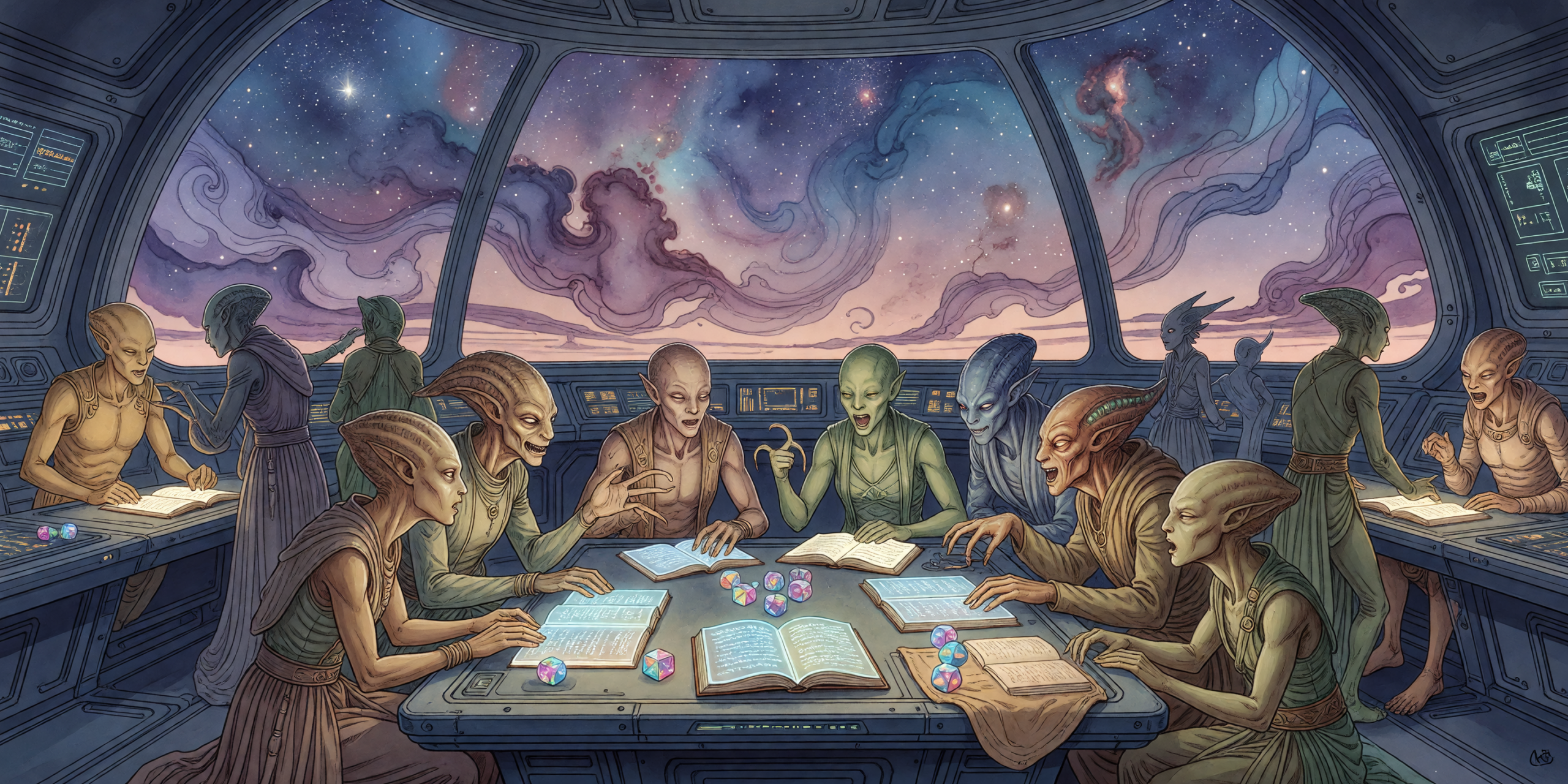
One would have thought Paizo might have grasped this sooner, but at last, they’ve deigned to release the public playtest for Starfinder Second Edition, complete with revised core rulebooks, streamlined character creation, and mechanics ostensibly refined by the feedback loops of the first edition’s rather pedestrian reception. As I’ve been reiterating in my published work since 2017—drawing on Propp’s morphology of the folktale adapted to interstellar semiotics—this was inevitable if the game hoped to transcend its derivative space opera trappings.
The Predictable Imperatives of Iterative Design
For those of you unfamiliar with the arcane arts of TTRPG evolution, Starfinder 1e laboured under the weight of Pathfinder’s d20 inheritance, producing a system as bloated as a neutron star. The playtest materials, available via Paizo’s blog until early 2025, promise ‘updated mechanics’—one assumes this means excising the more egregious crunchy excesses that Barthes would have dismissed as mere scriptible readerly drudgery. Streamlined character creation? How quaint; it’s almost as if community playtesters, those beleaguered souls, had been whispering hybridity into the void for years. I’ve long argued that sci-fi RPGs demand a Lévi-Straussian binary opposition between cosmic wonder and tactical tedium, and Paizo appears to have finally peeked at my seminar notes.
Amid the burgeoning vogue for space-faring TTRPGs—think Lancer‘s mecha semiotics or Lasers & Feelings‘ minimalist brilliance, the only works truly advancing the genre—Starfinder 2e positions itself as a major evolution. Yet, let’s not kid ourselves: this is less a revolutionary monomyth than a Campbellian hero’s return, tweaking ancestry, classes, and feats to better accommodate the galaxy-spanning narratives players crave. The invitation for community input is, of course, a performative nod to participatory culture, though one suspects the less academically inclined will flood forums with calls for more lasers rather than structural rigour.
*Sigh.* Paizo’s blog and EN World’s coverage confirm the playtest’s scope, but the real question lingers: will this address the first edition’s failure to fully mythologise its sci-fi folklore? Indie darlings like Impulse Drive have been doing this effortlessly for ages, weaving cyberpunk semiotics without the bloat.
The industry, predictably, will trumpet this as innovation while ignoring the deeper narrative paradigms I’ve outlined ad nauseam. One can only hope the playtesters prove me wrong—though they shan’t.
Elaine, “semiotic recalibration”? Spare us the pretentious jargon—this is a playtest for a sci-fi RPG, not your next tenure-track thesis. Starfinder’s always been Pathfinder in space suits; if it doesn’t break free from that orbit, it’ll die gasping like every other Paizo side project.